Quick answer
After a kitchen fire, cabinets, counters, tile, glass and most appliances outside the burn area can usually be cleaned with degreasers, but food, spices, open packages, warped plastics and blistered nonstick pans should be thrown out. Grease fires leave oily soot and burned food leaves a sticky protein film with a strong smell, and both need specific cleaners rather than household products.
Why kitchen fire residue is different
Most kitchen fires start with cooking fat or food. A grease fire leaves heavy, oily soot that smears when wiped. A pot left on the burner leaves protein residue: a thin yellowish film that can be almost invisible but carries a strong, lingering smell.
Both cling to every surface in the kitchen and drift into nearby rooms, especially in open floor plans. Household cleaners usually spread them around instead of removing them, which is why kitchens often still smell after a homeowner has scrubbed everything.
Cabinets, counters and walls
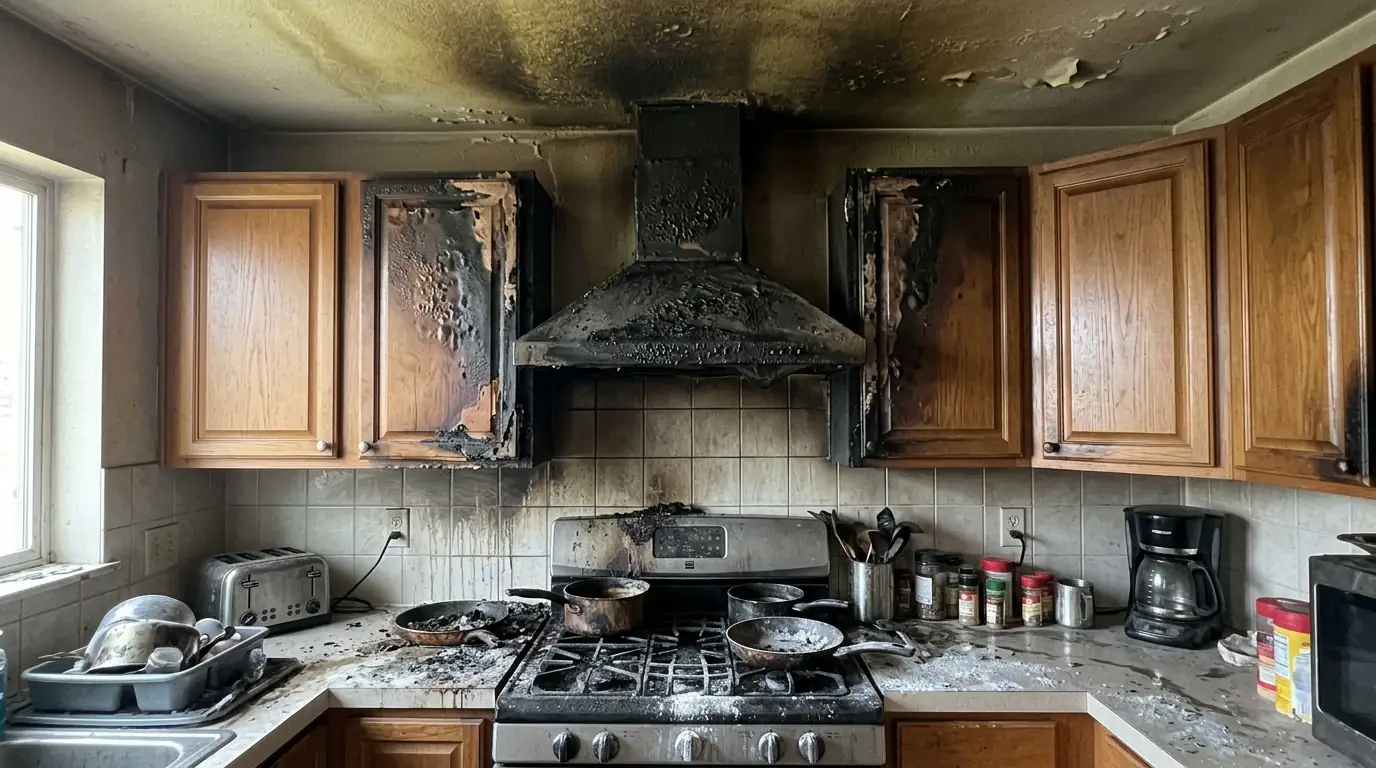
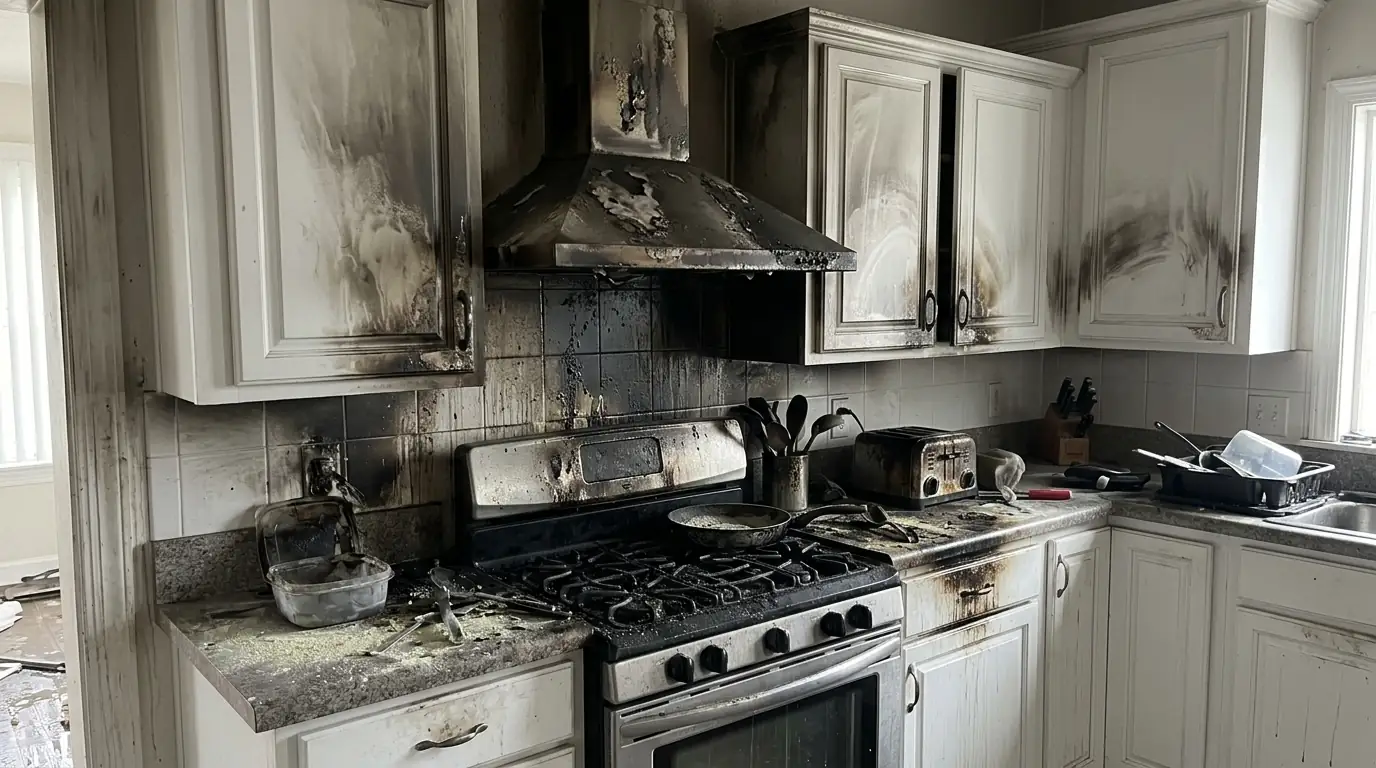
Cabinets away from the flames usually clean up, inside and out. Painted and finished wood is degreased, then refinished where the finish has clouded. Cabinets directly above the range that scorched, blistered or warped are usually replaced, and matching them to the rest is often the hardest part of the job.
Laminate counters that blistered near the heat are replaced; stone and solid surface counters usually clean, though heat can crack stone near the burner. Tile and backsplash clean well; grout that stained deep may need replacing. Walls and ceilings are degreased and, where yellowing remains, sealed and repainted.
Kitchen fire, even a small one? Call and we will tell you what can be cleaned before anything is thrown out.
Call (313) 391-5430Appliances
Appliances in the burn area, especially the range and the hood above it, usually go on the loss list. Appliances elsewhere in the kitchen often clean up: refrigerator, dishwasher and microwave fronts, handles and vents are degreased, and refrigerator coils are cleaned.
Do not use appliances that sat in heavy smoke until they are checked; residue can affect controls. A range hood the fire went up through should be replaced, not cleaned, and the duct behind it checked, because grease left in a duct is a fire risk of its own.
Dishes, pots and pans
Most dishes, glassware and metal cookware from closed cabinets just need a thorough washing. Items that sat open near the fire need degreasing first, then washing.
- Keep and wash: glass, ceramic and metal dishes from closed cabinets
- Keep and degrease: stainless and cast iron pans, then wash
- Throw out: nonstick pans with blistered or flaking coating
- Throw out: plastic containers and utensils that warped or softened
- Throw out: cutting boards and wooden utensils that charred
Food, spices and anything you eat or drink
This is where the answer is simple: when in doubt, throw it out. Food safety guidance after a fire is to discard food exposed to heat, smoke, soot or firefighting chemicals, including food in packages that are not airtight.
- All open food, spices, flour, sugar and snacks
- Food in cardboard, paper or plastic packaging near the fire
- Anything in a refrigerator that lost power for long
- Canned food that is bulging, rusted, dented or was exposed to high heat
- Medicines and vitamins kept in the kitchen
What to do yourself and what to leave
After a very small fire, with light residue on a few glossy surfaces, a homeowner can sometimes clean with a degreaser. Anything more than that is better handled with the right chemistry, so stains and odor are not set into the surfaces.
- Fine to do: throw out exposed food and photograph everything first
- Fine to do: wash dishes from closed cabinets
- Leave: degreasing ceilings, walls and cabinet boxes
- Leave: anything with the yellow protein film or strong odor
- Leave: the range hood, duct and appliances in the burn area
Kitchens in older Detroit houses
Older Detroit kitchens are often small and closed, with plaster walls and a short hood duct, so smoke from a stovetop fire concentrates and pushes into the rooms next door and up the stairs. In a small kitchen, almost every surface takes residue. Cleaning the soffits, the space above the cabinets and the rooms beside the kitchen is as important as cleaning the stove area, and our kitchen fire cleanup page covers how we handle it.
The rooms next to the kitchen
Kitchen smoke rarely stays in the kitchen. In open floor plans it coats the dining and family rooms in one pass; in closed older kitchens it pushes through doorways and up the stairs. Protein residue in particular travels well beyond what you can see, and the smell often shows up first in bedrooms and closets.
That is why a kitchen fire cleanup includes testing the rooms around the kitchen and the floor above, and why the furnace should stay off until the ducts are checked. A return vent near the kitchen can carry residue into every room the system serves.
How long a kitchen fire cleanup takes
A small stovetop fire with residue limited to the kitchen and a room or two can often be cleaned in a few days, including deodorizing. When cabinets, counters or the hood need replacing, the cleanup is followed by a rebuild that depends on cabinet and appliance lead times, usually a few weeks or more.
The fastest way through is to get the residue cleaned early, before it sets into paint and finishes, and to decide on replacement items while the cleaning is under way rather than after.
Kitchen fire questions
Often, if they were not scorched or warped. They are degreased inside and out and refinished where needed.
Throw out open food, spices and anything in non-airtight packaging that was exposed to heat or smoke. When in doubt, throw it out.
Protein residue from burned food is hard to see and needs specific cleaners and usually deodorizing.
Not if the coating blistered or flaked in the heat.
Not until it and its duct are checked. Hoods the fire went through should be replaced.