Quick answer
HEPA air scrubbing after a fire in Detroit uses portable machines that draw room air through a HEPA filter, which captures at least 99.97 percent of particles at 0.3 microns, to clear fine soot during and after cleanup. Set up with ducting to the outside, the same machines create negative air pressure that keeps soot and dust inside containment while tear-out and cleaning are under way.
Why the air needs cleaning as well as the surfaces
Fire produces particles in a wide range of sizes. The larger ones settle quickly; the finest stay suspended for hours and are stirred up again by every footstep, every door and every sweep of a cleaning cloth.
Without air filtration, cleaning crews end up chasing the same soot from surface to surface. Air scrubbers capture it from the air so it does not resettle, and keep it from drifting into rooms that are already clean.
They also matter for the household. When people stay in part of the house during the work, cleaner air in the lived-in rooms is worth the equipment.
How HEPA air scrubbing runs
- 01
Size the equipment
Machines chosen for the room volumes and the work planned.
- 02
Set containment
Work zones sealed and put under negative air.
- 03
Run during cleanup
Scrubbers capture soot as cleaning and tear-out stir it up.
- 04
Change filters
Pre-filters and HEPA filters replaced and bagged as they load.
- 05
Run after cleanup
A period of filtration after cleaning so the air finishes clean.
Negative air containment
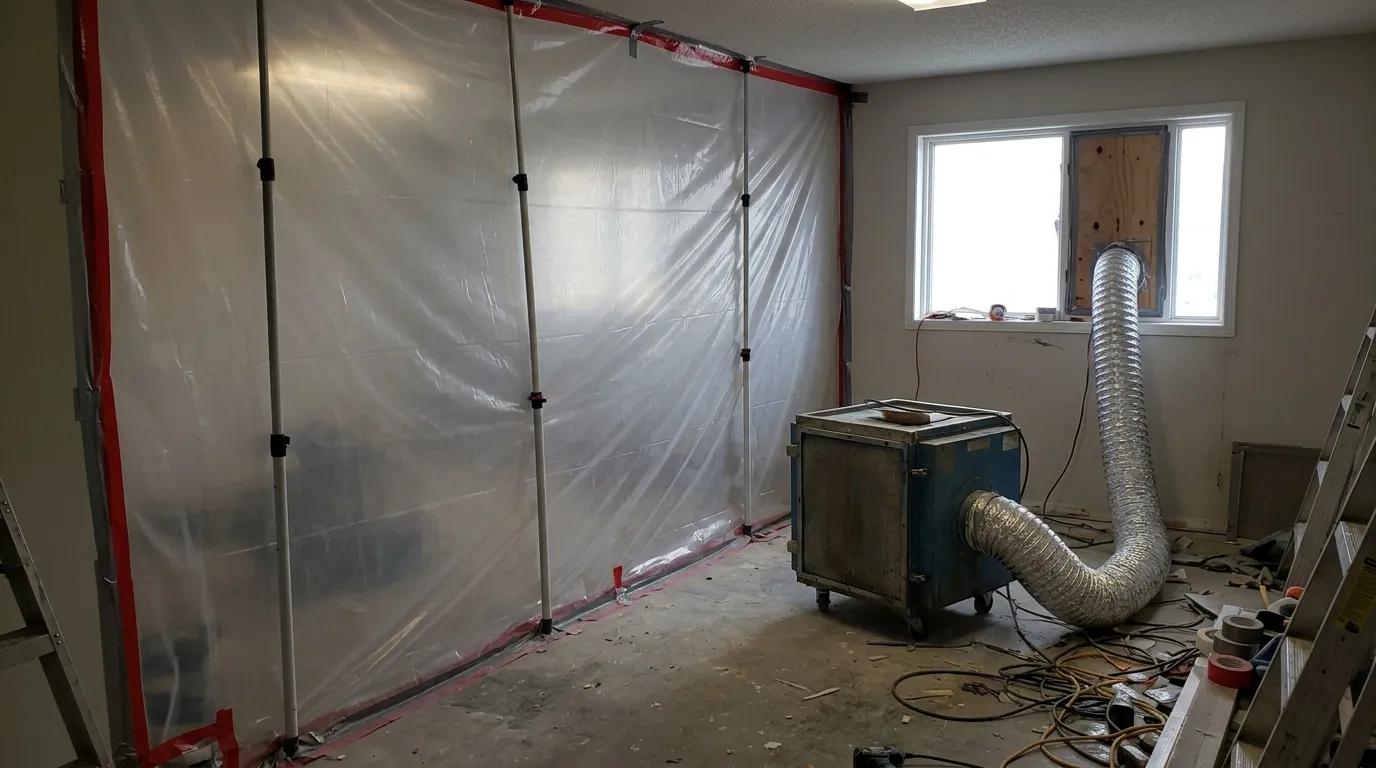
During tear-out and heavy cleaning, the work area is sealed with plastic sheeting and zipper doors, and an air scrubber exhausts air from inside the containment to the outside through a duct. That keeps the containment under slightly lower pressure than the rest of the house.
With negative pressure, air flows into the work zone at any gap rather than out of it, so soot, dust and debris stay inside. We check that the plastic draws inward, which shows the setup is working, and change filters on a schedule.
Fine soot particles
Fine soot is what makes rooms feel gritty and what settles back as a gray film after cleaning. HEPA filters capture particles down to the sizes that stay airborne longest, and pre-filters protect the HEPA from the heavier dust of tear-out.
We run scrubbers throughout cleaning and for a period afterward, sized to the volume of each room so the air is filtered several times an hour. Filters are bagged and disposed of carefully, since they hold the soot they captured.
Cleaning the air in an occupied home
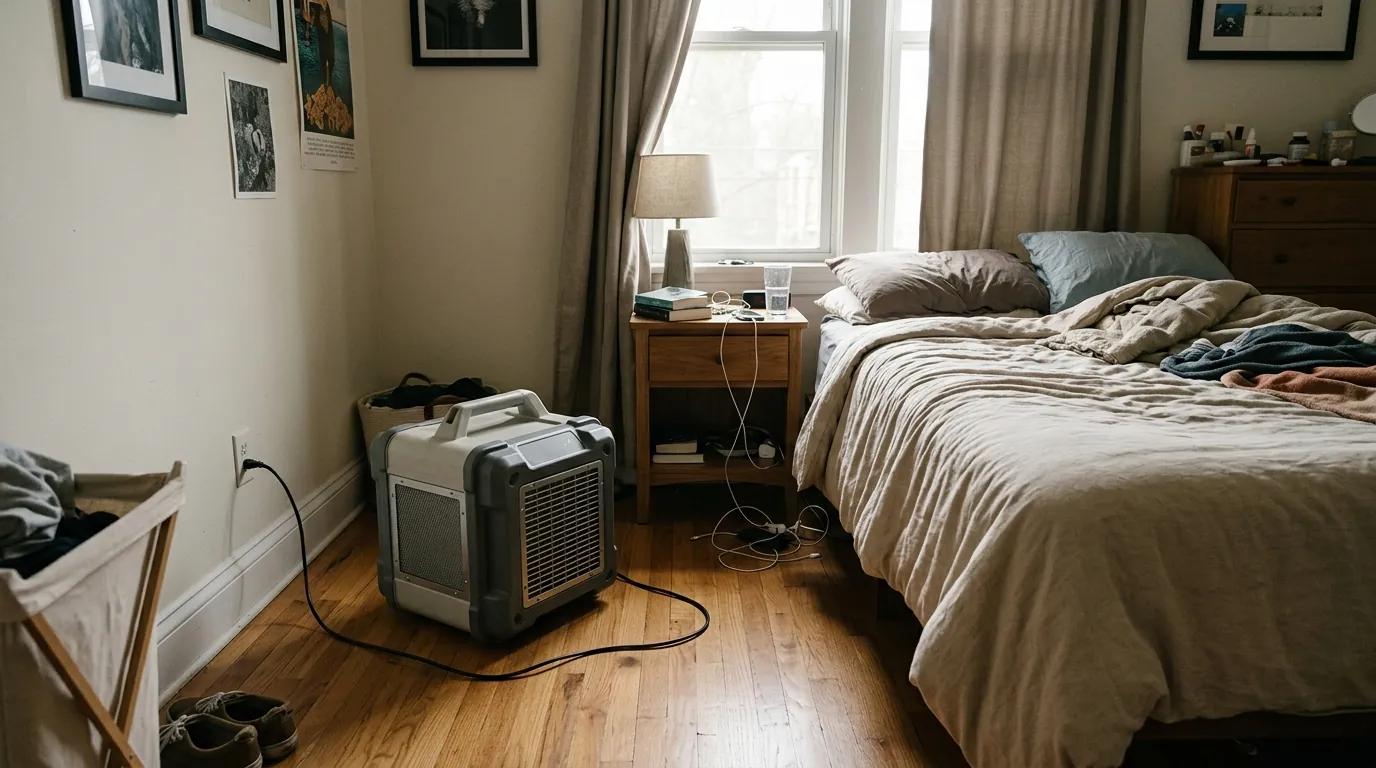
When a family stays in the house during the work, we set scrubbers in the lived-in rooms to recirculate filtered air, separate from the containment machines exhausting the work zone. Bedrooms get priority, especially for children, older adults and anyone with asthma.
Scrubbers are quieter than they look, but they do run continuously. We place them to keep noise away from bedrooms at night where possible, and show you how to move or switch one if you need to. Machines are checked on every visit and filters changed before they load up, so airflow stays strong.
Fine soot in the air after the fire? Call and we will set up filtration while the cleanup runs.
Call (313) 391-5430Plastic smoke from electrical fires in Detroit
Electrical fires are the top cause of accidental residential fires in Detroit, according to the city's fire department, and they burn a lot of plastic: wire jacketing, outlets, power strips and electronics. Plastic smoke is especially fine and stays airborne longer than wood smoke, which is why air scrubbing is part of nearly every electrical fire cleanup we do in the city, and why we keep scrubbers running for a while after the visible soot is gone.
What helps and what does not while you wait
Helps
- Keeping doors to smoky rooms closed
- Changing the furnace filter, with the system off
- Running a household HEPA purifier in a bedroom
- Opening windows when it is safe and dry
Does not help
- Running the furnace to move air
- Using fans in smoky rooms
- Sweeping soot with a broom
- Vacuuming with a non-HEPA vacuum
HEPA scrubbers, household purifiers and odor treatments
| HEPA air scrubber | Household air purifier | Odor treatment | |
|---|---|---|---|
| Captures fine soot | Yes, large volume | Some, small rooms | No |
| Negative air | Yes, when ducted outside | No | No |
| Removes odor | Partly, with carbon filters | Partly | Yes, after cleaning |
| Best for | Cleanup and containment | Ongoing use after the job | Residual smell |
What changes the cost of HEPA air scrubbing
Air scrubbing is priced by the number of machines and how long they run.
- Number of scrubbersSized to the volume of the rooms being treated.
- Days of operationRunning through cleanup and for a period afterward.
- ContainmentPlastic sealing and ducting for negative air.
- FiltersPre-filters and HEPA filters replaced as they load.
- Occupied roomsExtra machines for rooms the household is using.
HEPA air scrubbing questions
A filter that captures at least 99.97 percent of particles at 0.3 microns, the size that is hardest to catch.
It does the same job at a much larger scale, and it can be ducted outside to create negative air.
Partly, especially with carbon filters, but odor comes from residue on surfaces, which has to be cleaned.
Often, yes. We set separate machines for the rooms you are using.
Through cleanup and for a period afterward, usually days.
Cleaning and then odor treatment. See smoke odor removal.
