Quick answer
Soda and dry ice blasting in Detroit removes surface char and soot from framing, joists, trusses and masonry after a fire so sound wood can stay. Soda blasting uses baking soda media that also helps neutralize odor; dry ice blasting leaves no media behind. Both are followed by sealing the framing with an odor-blocking primer before walls and ceilings close.
Cleaning framing instead of replacing it
After tear-out, the framing behind walls and ceilings is often black. Some of it is burned deep enough to weaken the member; much of it is only a thin layer of char and soot on sound wood. Scraping and sanding that by hand is slow and uneven, and it leaves odor in the grain.
Blasting removes the char evenly down to clean wood. We probe members first, so only framing that is structurally sound gets blasted; members that lost too much depth are sistered or replaced.
After blasting, the framing is vacuumed, checked again and sealed. That seal is what keeps residual odor from coming back through new drywall.
What drives the cost of soda or dry ice blasting
Blasting is priced by the surface area of framing or masonry and the method used.
- Area of framingSquare footage of rafters, joists, studs or masonry to be cleaned.
- Soda or dry iceDry ice costs more to run but saves media cleanup.
- ContainmentSealing the area and running negative air adds setup.
- Structural repairSistering or replacing members that lost depth.
- Sealing afterwardOdor-blocking primer on all blasted surfaces.
Soda, dry ice or hand sanding
| Soda blasting | Dry ice blasting | Hand sanding | |
|---|---|---|---|
| Media left behind | Yes, fine soda residue | None | Dust |
| Odor help | Yes, soda neutralizes | Cleans only | Cleans only |
| Speed on open framing | Fast | Fast | Slow and uneven |
| Best for | Attics, basements, gutted rooms | Near finishes and equipment | Small spots |
Soda blasting
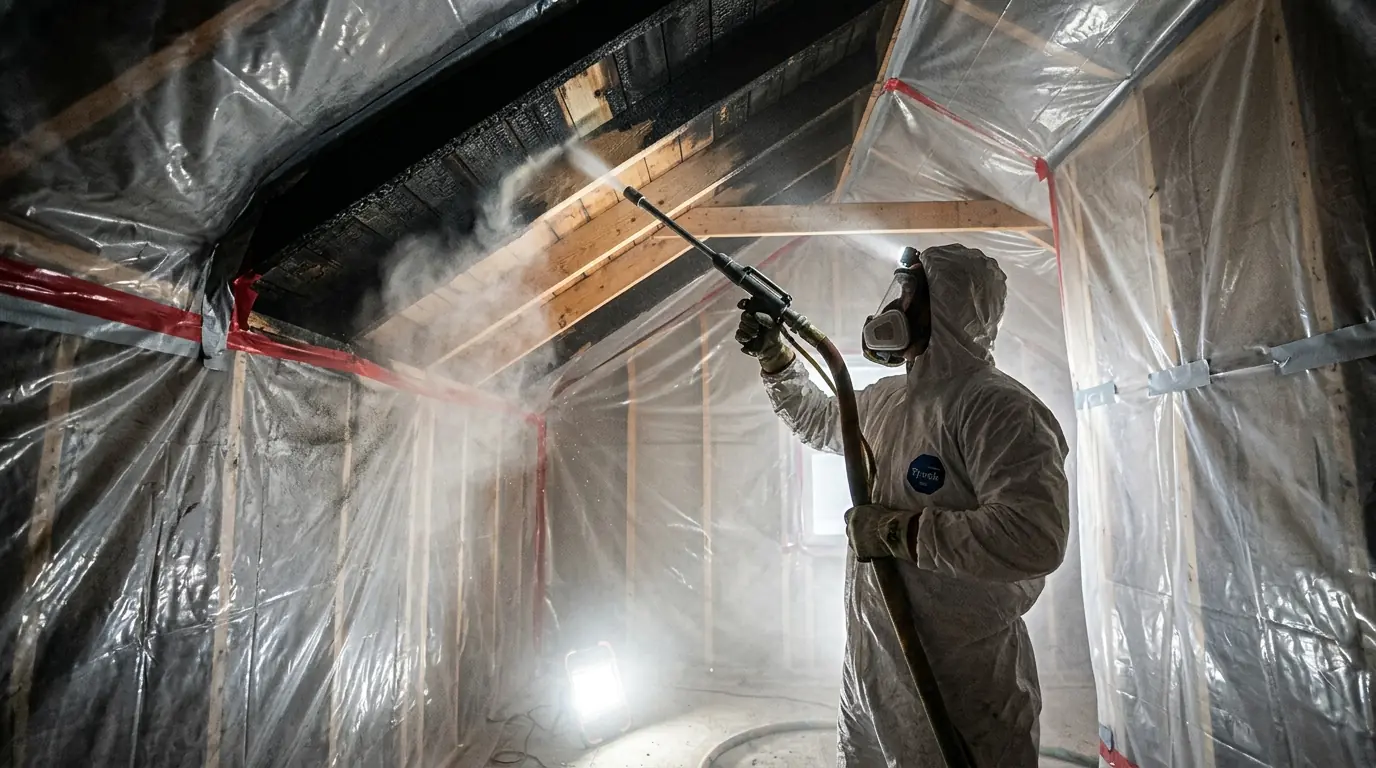
Soda blasting uses sodium bicarbonate media at lower pressure than sandblasting. It lifts char and soot off wood, brick and block without cutting deep into the surface, and the soda helps neutralize smoke odor as it goes.
The media leaves a fine white residue that has to be contained and cleaned up, so we seal off the work area, run negative air and vacuum everything afterward. Soda blasting is usually the most economical choice for open framing in attics, basements and gutted rooms where cleanup of the media is straightforward.
Dry ice blasting
Dry ice blasting uses pellets of frozen carbon dioxide that turn to gas on impact, so there is no media left to clean up. That makes it the better choice around finished areas, mechanical equipment, electrical components and places where soda residue would be hard to remove.
It costs more to run and the carbon dioxide has to be ventilated, so the area is cleared of people and air moves to the outside. We use it where clean-up is the bigger cost, like finished basements next to living space or commercial spaces with equipment nearby.
Char removal on joists
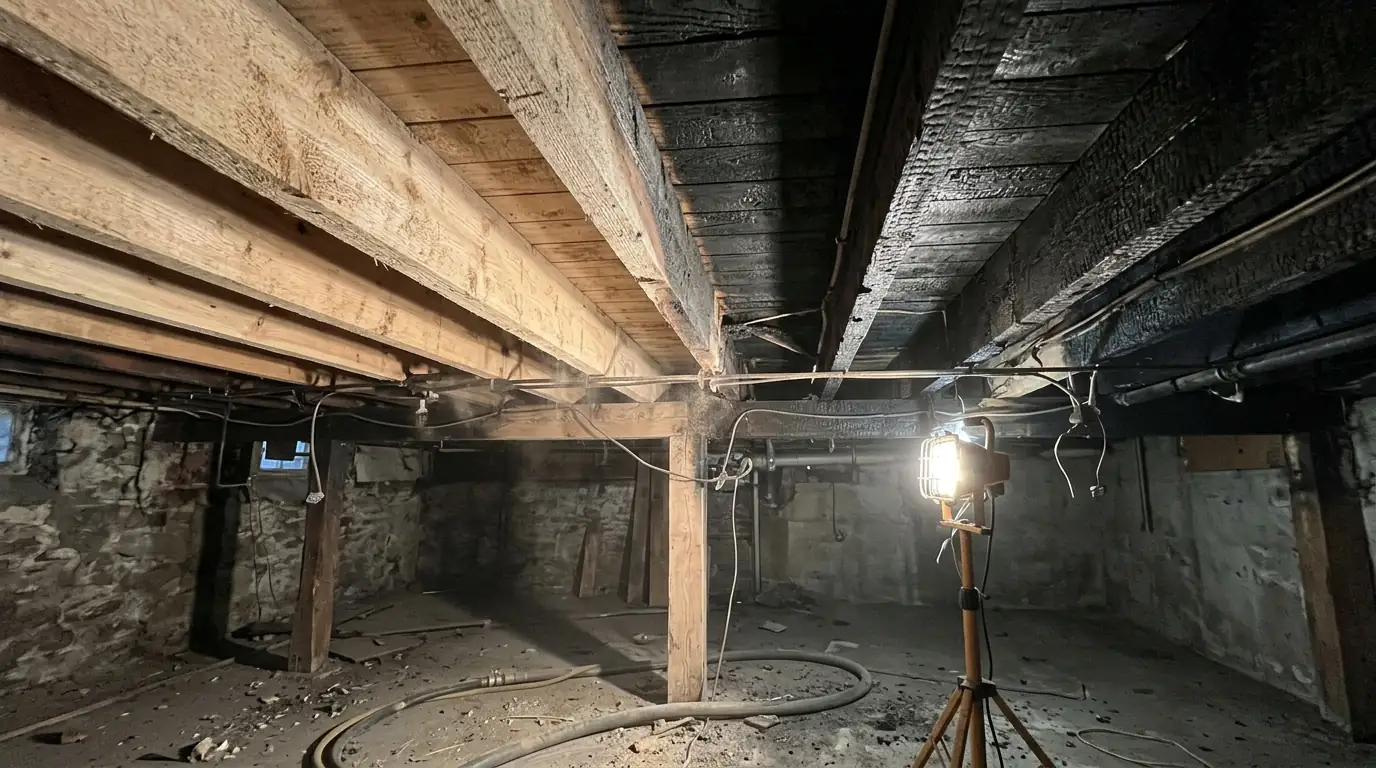
Floor joists under a burned room take heat from above and firefighting water from the floor. We probe each joist to find how deep the char goes. Surface char is blasted off; joists that lost structural depth are sistered with new lumber or replaced, with a permit when the repair calls for one.
Once the char is off and the wood is dry, the joists are sealed with an odor-blocking primer. Subfloor that charred through is replaced, since a blasted subfloor rarely stays flat under new flooring.
Black framing after tear-out? Call and we will tell you what can be cleaned and what has to be replaced.
Call (313) 391-5430How a blasting job runs
- 01
Probe every member
We check how deep the char goes before deciding what to blast.
- 02
Contain the area
Plastic sealing and negative air keep media and soot in the work zone.
- 03
Blast
Soda or dry ice removes char and soot down to clean wood or masonry.
- 04
Clean up and recheck
Vacuuming, then a second look at every member.
- 05
Seal
Odor-blocking primer goes on before insulation and new walls.
Blasting framing in Detroit's older houses
About 80 percent of Detroit's housing was built before 1960, which means a lot of the framing we open up is old-growth lumber that is denser than modern studs and often worth saving. It also means cavities that run floor to floor in many older houses, so smoke reaches framing far from the fire. Blasting lets us clean that framing in place instead of replacing sound wood, and sealing afterward keeps odor from traveling back up through those cavities.
How long blasting takes
An attic or a basement ceiling is usually blasted in one to a few days, including containment and cleanup, once tear-out is finished and the framing is dry.
Structural repairs, inspections and sealing follow before insulation and new drywall go in.
Soda and dry ice blasting questions
Not if the char is only on the surface. Framing that lost too much depth does; we probe each member to decide.
Yes, when the area is contained. The soda residue is cleaned up afterward and the media is not toxic, though we keep people out while blasting.
Dry ice leaves no media, so it suits areas near finishes, equipment or living space where cleanup would be hard.
Not if the framing is sealed afterward. Blasting removes most of the char; sealing blocks what is left in the grain.
Yes. Brick, block and stone clean well with soda or dry ice.
Sealing, then insulation and new walls. See smoke sealing and repainting.
