Quick answer
Document and photo restoration after a fire in Detroit depends on speed: wet paper, books and photos are packed and frozen within a day or two to stop mold and sticking, then dried later with a controlled freeze-drying process. Dry, smoke-stained items are cleaned by hand and deodorized. Anything that cannot be recovered is photographed and listed for your claim.
Why paper needs its own recovery process
Paper absorbs water quickly and holds it. Within a couple of days, wet pages start growing mold, coated photo paper sticks together and ink can run. Smoke adds a yellow film and a smell that lingers in books long after the house is clean.
The first goal is to stop the clock. Freezing wet paper halts mold growth and keeps pages from bonding while the rest of the house is dealt with. Recovery then happens under controlled drying, rather than on a kitchen table.
We handle family photos, personal papers, household records and books. Very old, rare or valuable items may go to a conservator, and we will tell you when that is worth it.
What changes the cost of document and photo recovery
Paper recovery is priced by volume and by how much hand work each item needs.
- VolumeA few boxes cost far less than a room full of books and files.
- Wet or only smokyWet paper needs freezing and freeze-drying; smoky paper only cleaning.
- PhotosSeparating and cleaning prints is hand work, print by print.
- Rare or valuable itemsItems worth a conservator's time cost more to treat.
- ScanningDigitizing damaged photos or records adds time per item.
What to do with wet photos and papers before we arrive
Helpful to do
- Keep wet photos wet in cool clean water if they will be handled within a day
- Put wet papers in freezer bags and freeze them
- Keep albums and books flat or upright, not stacked
- Photograph boxes before moving them
Avoid
- Pulling stuck photos apart
- Drying wet books with a hair dryer or heat
- Wiping smoke off prints with a household cleaner
- Throwing away records before listing them
Freeze-drying wet paper
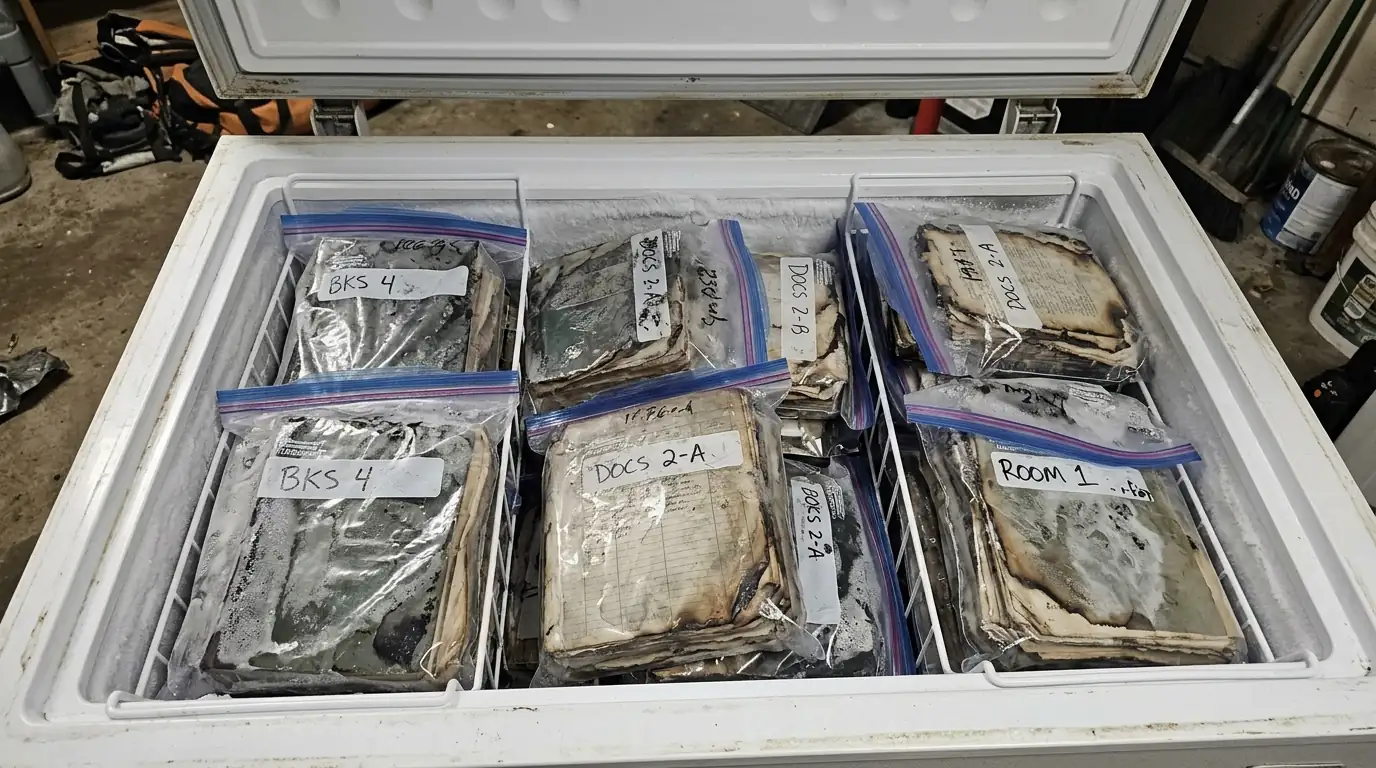
Wet documents and books are packed flat or spine down in freezer bags or boxes, labeled by room and frozen. Freezing stops mold and ink bleeding, and it buys time to deal with the house before deciding what to recover.
Recovery uses vacuum freeze-drying, where frozen water turns directly to vapor without passing back through liquid. That keeps pages from cockling and sticking as badly as air drying would. Afterward, items are cleaned of soot and deodorized, and you get them back boxed by the room they came from.
Smoke-stained photographs
Prints behind glass or in albums often survive better than people expect, because the frame or sleeve took most of the smoke. We remove them carefully, since prints that got wet can stick to glass, and separate stuck prints only when they can be freed without tearing the image.
Dry smoke film is cleaned from the print surface with methods safe for photo emulsion. Where a photo is too damaged to clean, we keep it for you and can scan what remains, so the image is not lost even if the print is. Albums with plastic sleeves are often replaced after the photos are removed.
Books and records
Books that are only smoky get their covers and page edges cleaned and are deodorized in a sealed chamber. Books that got wet are frozen first, then freeze-dried, and their spines and bindings checked once they are dry.
Household records, like tax papers, deeds, medical files and business records, are handled with the same care and kept together by folder. Where an original cannot be saved, we note what it was so you know what to request copies of, from your bank, your county or your doctor, for example.
Wet photos or papers after the fire? Call now; freezing them in the first days is what saves them.
Call (313) 391-5430How paper recovery runs
- 01
Find and triage
Wet paper is separated from dry, smoky paper on the first visit.
- 02
Freeze what is wet
Wet items are bagged, labeled by room and frozen.
- 03
Freeze-dry
Frozen items are dried under vacuum to limit cockling and sticking.
- 04
Clean and deodorize
Soot is cleaned from covers, edges and prints; odor treated in a chamber.
- 05
Return and list
Recovered items come back boxed by room; losses are listed.
Papers stored in Detroit basements
Homes on Cliff Street near our service office include 1941 brick bungalows with partly finished basements, and like many Detroit houses of that era, the basement is where boxes of records, photo albums and old books end up. After a fire upstairs, firefighting water runs down into that storage. We check basement shelves and boxes on the first visit, and move anything paper that is wet into freezer storage before it starts to mold.
How long recovery takes
Freezing happens right away, often on the first or second visit. After that there is no rush; frozen paper can wait while the house is repaired.
Freeze-drying and cleaning usually take a few weeks, depending on how much there is. Photos and rare items that need hand work take longer.
Document and photo recovery questions
Often, if they are handled quickly. Keep them from drying stuck together and call; we freeze or separate them before the emulsion bonds.
Freezing stops mold and keeps pages from sticking, which buys time until they can be freeze-dried properly.
Usually, once covers and edges are cleaned and the books are deodorized in a sealed chamber.
We recover what we can and list what cannot be saved, so you know what copies to request.
Yes, when a print is too damaged to clean, a scan can preserve the image.
They go through our contents cleaning process alongside the paper.
